"Precision Craftsmen" in shipbuilding, a powerful tool for controlling ship body accuracy and achieving efficient production. The measurement pain points in shipbuilding are centered around "large volume, harsh conditions, height, and difficult operations", covering the entire production process.
The measurement challenges of large-sized valve bodies and the solution path of the joint arm
Release Date:2026-03-06 Click:4
Introduction In the industrial manufacturing sector, large-diameter valve bodies, as the core components of fluid control systems, their precision directly affects the safety, stability and efficiency of the entire equipment operation. From energy and chemical industries to high-end equipment manufacturing, such valve bodies often have the characteristics of large size, complex structure, and numerous hole systems. They place extremely high demands on multiple key indicators such as dimensional accuracy, positional tolerance, and sealing performance. They must not only meet sealing and flow channel efficiency requirements but also ensure ease of assembly and maintenance. The traditional fixed detection methods, due to cumbersome tooling, time-consuming workpiece transportation, and poor flexibility, have become a bottleneck restricting production efficiency and quality control response. However, the articulated arm measuring machine, with its ability to reach the site, high flexibility, and the compatibility of touch sensing and scanning, provides more stable and efficient technical support for the full-chain detection of the first inspection, patrol inspection, pre-inspection before assembly, and rework confirmation of large-diameter valve bodies.
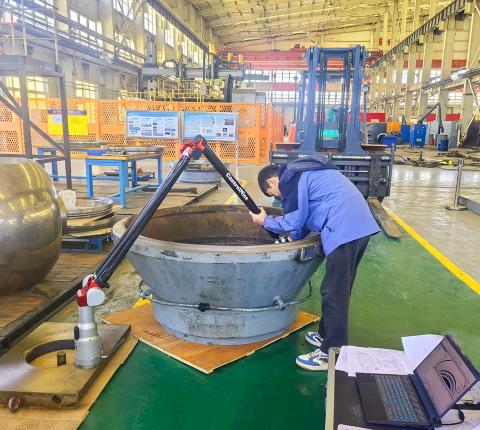
图1 技术工程师测量大口径阀体
1. Why does a complete set of detection for large-diameter valve bodies require a specialized plan? The manufacturing accuracy requirements for large-diameter valve bodies are extremely strict. Whether it is the dimensional tolerance of the internal flow channels, the shape and position tolerance of the sealing surfaces, or the assembly accuracy of each interface, any minor deviation can lead to leakage, pressure loss, or even system failure. However, its own characteristics pose multiple challenges for detection: 1. The large size and weight make it difficult to transport to a fixed detection platform, and the detection range and flexibility of traditional three-coordinate measuring machines are limited. 2. The structure is complex, containing a large number of deep holes, blind holes, and curved surfaces, and conventional measuring tools are unable to fully cover them. 3. It is necessary to balance the overall assembly accuracy with local detail dimensions, and the detection dimensions are numerous and highly interrelated, with high requirements for data integrity. Traditional detection methods indeed cannot meet its "high precision, high efficiency, and all-round" combined requirements.
II. Joint Arm Measuring Machine: The Core Advantage for Solving the Pain Points in Large-Diameter Valve Body Inspection
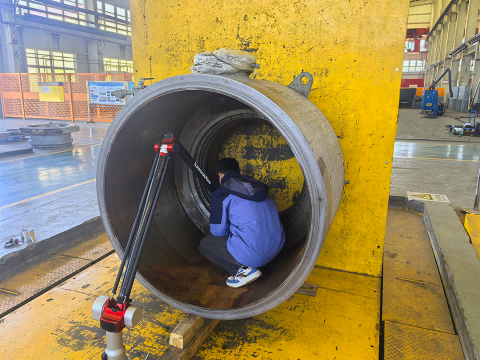
The articulated arm measuring machine, with its unique structural design and technical characteristics, has become the ideal choice for the overall detection of large-diameter valve bodies. Its core advantages are reflected in the following three aspects: 1. Flexible adaptation, breaking through spatial limitations The articulated arm measuring machine adopts a multi-axis联动mechanical arm structure, combined with a movable base, which can directly enter the complex inner cavities of large-diameter valve bodies or approach the outer surfaces of extremely large sizes for detection. Without disassembling or transferring the valve body, it can achieve the detection mode of "the workpiece remains stationary while the equipment moves", which has high adaptability for online detection of heavy and large-diameter valve bodies, significantly reducing transportation costs and secondary clamping errors.
图2 技术工程师测量大口径阀体
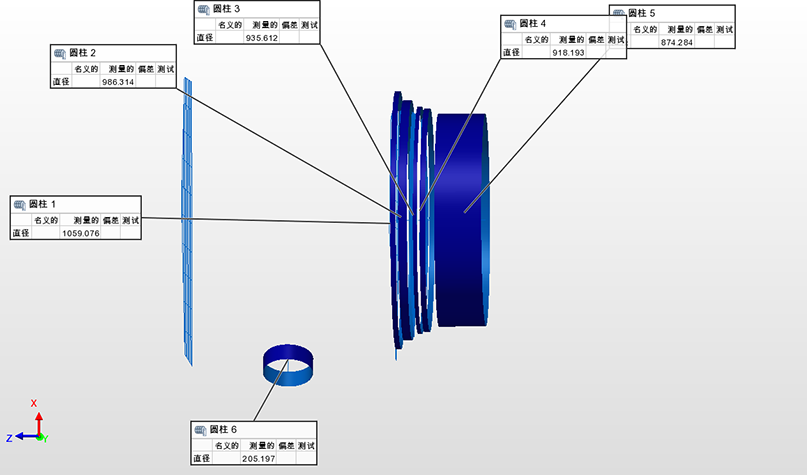
2. High precision and high compatibility, covering all-dimensional detection requirements Relying on technologies such as intelligent probes, the joint-arm measuring machine can not only accurately capture the microscopic dimensions of the valve body surface (such as the depth and width of the sealing groove), but also restore the shape and position tolerances of the overall structure through three-dimensional modeling (such as axis parallelism and flatness). At the same time, it is compatible with multiple detection software, which can compare the measurement data with the CAD model in real time, quickly identify out-of-tolerance items, and meet all-dimensional detection requirements from a single component to the assembly relationship of the entire valve body.
图3 大口径阀体数据图
3. Efficient integration, empowering the entire manufacturing process The detection process of the articulated arm measuring machine does not interrupt the production line and can seamlessly connect with the processing stage, achieving a closed-loop control of "on-the-line detection". For large-diameter valve bodies in batch production, its rapid data acquisition and analysis capabilities can promptly provide detection data, enabling enterprises to optimize processing parameters and providing a reliable basis for product quality traceability. III. Technological Empowerment: A Leap from Detection Accuracy to Industrial Value The geometric quality control of large-diameter valve bodies mainly relies on "unified benchmark, clear relationship, and available data". The joint arm measuring machine is not merely a simple replacement for traditional inspection. When the inspection shifts from "result recording" to "decision support for assembly and process", its application in valve body inspection is not only an upgrade of inspection technology, but also promotes the quality improvement and efficiency optimization of related industries. By precisely controlling the valve body's accuracy, energy loss and maintenance costs during equipment operation can be reduced, and the service life of the system can be extended. In the field of high-end equipment, its monitoring data can also guide the iterative design of valve bodies in reverse, accelerating the new product development cycle. 4. Conclusion In the future, as the precision requirements of industrial manufacturing continue to increase, the articulated arm measuring machine will further integrate with automation and intelligent technologies, providing a more efficient and intelligent solution for the inspection of large and complex components. It will truly become a key force in ensuring the quality of products in the shipbuilding industry.





 Return


