IntroductionIn the automotive manufacturing industry, interior components, due to their advantages such as lightweight, low cost, and flexible design, are widely used in interior parts (such as dashboards and door panels), exterior parts (such as bumpers and lamp housings), and other key functional areas. The dimensional accuracy and shape tolerance of these interior components directly affect the assembly efficiency, safety of use, and user experience of the vehicle. Moreover, the high-quality and high-efficiency production completion rate is a manifestation of the core competitiveness of the enterprise.
The joint arm measuring machine, as an advanced portable measuring device, provides reliable support for the entire process of automotive interior component production through its precise, flexible, and efficient measurement capabilities, and has become the key choice for enterprises to achieve dual improvements in efficiency and quality.
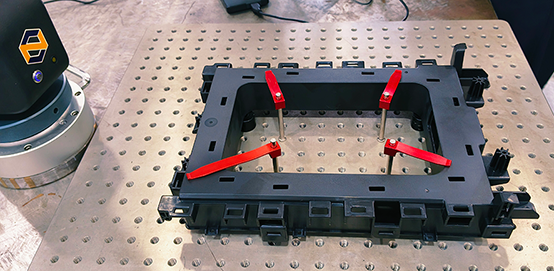
I. The Main Challenges in Measuring Automotive Interior Components1. Deformation caused by materials and processes: Interior components are prone to warping, uneven shrinkage, and inconsistent surface gloss during injection molding, cooling, and processing. It is necessary to detect shape deviations and their relationship with assembly positions.
2. Complex curved surfaces and thin-walled structures: Traditional calipers and micrometers are unable to fully measure the detailed features such as the shape of complex curved surfaces and surface fasteners.
3. Assembly and connection: The positions of holes, positioning surfaces, the height of fasteners, and the tolerance of fit directly affect the subsequent assembly efficiency and reliability.
4. Batch production and sampling inspection: Full inspection is costly and time-consuming, while sampling inspection requires high representative detection methods and the ability to provide results quickly.
II. How does the joint arm measuring machine address these challenges?1. Portable and online detection: Reduces assembly and transportation time, as well as the risk of wear on the detection components. Suitable for large items or measurement on assembly lines.
2. Adaptation to complex curved surfaces: Has high scanning efficiency and large data density for free-form surfaces and interior components with significant curvature changes, facilitating shape analysis and reverse engineering.
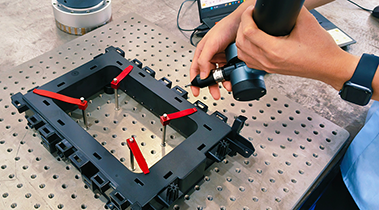
3. Quick result generation, support for sampling inspection and first-piece testing: The measurement cycle is short, suitable for rapid feedback and immediate adjustments in response to production anomalies.
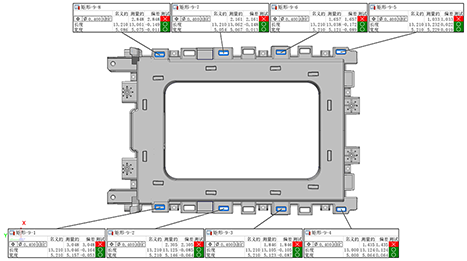
4. Support for digitalization and quality traceability: Point clouds, chromatographic deviation graphs, measurement records, and inspection reports can be directly saved, facilitating quality trend analysis and archiving.
III. The joint arm measuring machine enables the entire production process of automotive interior componentsThe joint-arm measuring machine directly contributes to the improvement of production efficiency and quality control in the automotive interior component manufacturing process by participating in all stages of the production.
1.Real-time quality control during the production process
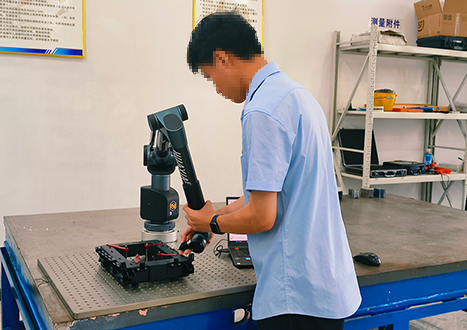
Most automotive interior components are made through injection molding, which is prone to size deviations due to mold wear and fluctuations in process parameters. The joint arm measuring machine can quickly conduct spot checks or full inspections beside the production line, accurately measuring key dimensions (such as: hole spacing, complex curved surfaces), reducing rework rates and improving product qualification rates.
2. Efficient Data Acquisition in Reverse Engineering
When an enterprise needs to upgrade existing interior components, the blue light scanning function of the joint arm measuring machine can complete the three-dimensional modeling of complex parts within a few minutes.
3. Precise Basis for Mold Maintenance
Mold accuracy determines the quality of interior components. The joint arm measuring machine can directly measure the key dimensions of the cavity and core in the mold workshop, evaluate wear or deformation data. Through regular measurements, the enterprise can plan the mold adjustment time in advance, avoiding production stagnation due to sudden failures and ensuring the efficient execution of the production plan.
4. ConclusionThe articulated arm measuring machine, with its advanced features such as high precision, high efficiency and portability, is transforming the quality control model for automotive interior components. From prototype verification during the design and development stage to online detection during the production process, the articulated arm measuring machine is applied throughout the entire production process of interior components, helping automakers achieve high-quality and high-efficiency manufacturing goals. With the deep advancement of Industry 4.0 and intelligent manufacturing, the articulated arm measuring machine will become an indispensable key infrastructure in automotive digital factories, providing solid measurement support for the precision and lightweight development of the automotive manufacturing industry.





 Return


