In the automotive manufacturing process, the material rack serves as a crucial carrier for the logistics turnover of components. Its structural accuracy directly affects the efficiency of automated assembly and quality control. Among various detection methods, the portable joint-arm measuring machine, due to its high precision and flexibility, is becoming an important tool for precision management in automotive enterprises.
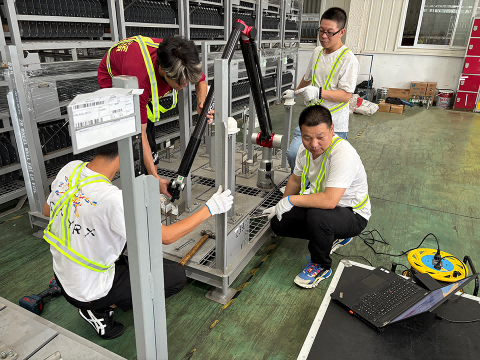
I. Why is it necessary to control the accuracy of the material rack?
In the automotive manufacturing workshop, the material rack mainly undertakes the tasks of transporting and positioning welding parts, covering parts, interior parts, etc. When the positioning accuracy of the material rack begins to affect the success rate of AGV's picking up, it will directly lead to:
1. Deviation of the supply position, resulting in failure of robot grasping
2. Deformation or collision of components, affecting assembly quality
3. Non-conformity of offline quality inspection, increasing rework costs
Therefore, conducting efficient and precise size detection on the material rack is a key link to ensure the stable operation of the production line.
II. Solution:
By using intelligent detection equipment such as the joint arm measuring machine, it can quickly obtain the full-size three-dimensional data of the material rack, automatically compare with the CAD design model, and identify deformation, wear, or assembly deviations.
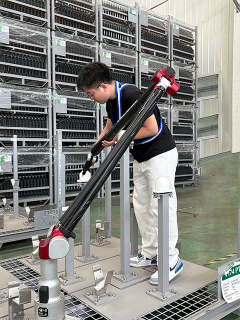
III. Core Advantages of the Portable Joint Arm Measuring Machine
1. High measurement accuracy, good stability, and strong adaptability to the environment
The joint arm is equipped with an intelligent measuring head, which offers high measurement accuracy and strong flexibility. It can meet the high-precision detection requirements for complex curved surfaces.
2. Portable and flexible, enabling on-site measurement
Unlike traditional three-coordinate equipment which is limited by the measurement chamber, the joint arm measuring machine can be directly deployed at the production site, achieving "zero transfer" and "immediate measurement and adjustment", significantly improving the speed of data detection.
3. Data digitization, facilitating traceability and analysis
The measurement data can be instantly generated as a three-dimensional model, and systematically fitted with reference points to achieve visualized deviation; at the same time, it supports the import of various common three-dimensional CAD formats such as IGES and STEP, assisting in quality monitoring and improvement.
IV. Examples of Application Scenarios
√ Initial inspection of newly developed material shelves: Quickly verify the consistency between the design drawings and the physical objects
√ Traceability of production line abnormalities: Locate the deformation points of the material shelves, accelerating the repair speed
√ Periodic inspections: Incorporate into the quality management plan to ensure the stability of usage
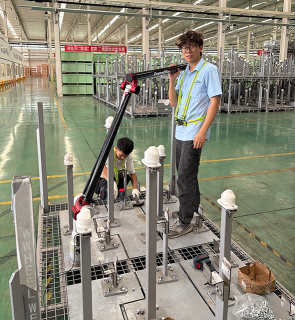
V. Summary
In the context of the accelerated advancement of automotive intelligent manufacturing, precision management is no longer the exclusive domain of "highly precise parts". Even the "peripheral equipment" such as material racks have begun to be incorporated into the digital inspection system.
Through the combination of the aforementioned technologies and the closed-loop process, using a portable joint-arm measuring machine, it is possible to conduct comprehensive, rapid, and intelligent inspections of the dimensions of material racks, providing a fundamental support for the stability of the production line and becoming the core assistant for the quality upgrade of automotive manufacturers.






 Return


