The "precise indicator" for energy manufacturing, a powerful tool for controlling the accuracy of battery cells and achieving efficient mass production. The measurement challenges in the new energy field revolve around "high precision, small size, multiple batches, and strong cleanliness", covering the entire production and operation process.
The joint arm measuring machine enables high-precision manufacturing of hydraulic piston rods in hydropower stations
Release Date:2025-12-26 Click:4
In hydropower station projects, the hydraulic piston rod is responsible for critical tasks involving high loads, long strokes, and frequent start-stop operations. The geometric accuracy of the hydraulic piston rod is crucial for its reliability and lifespan. Even a slight error can lead to seal failure, uneven load wear, or overall shutdown. The portable joint arm measuring machine, with its features of on-site measurement, three-dimensional visualization, and traceable data, has become a key quality control tool for the production and on-site installation inspection of hydropower station hydraulic piston rods.
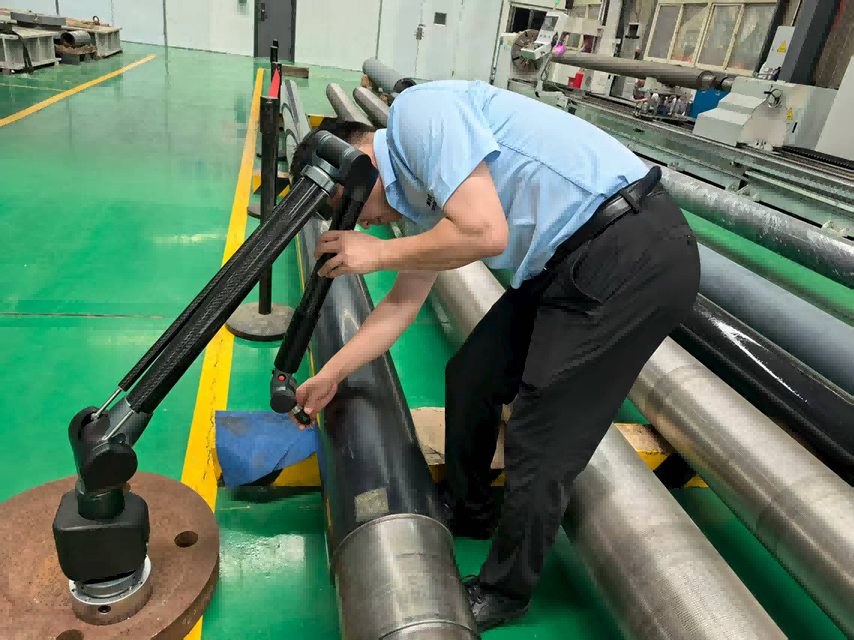
‖图1 技术工程师测量活塞杆
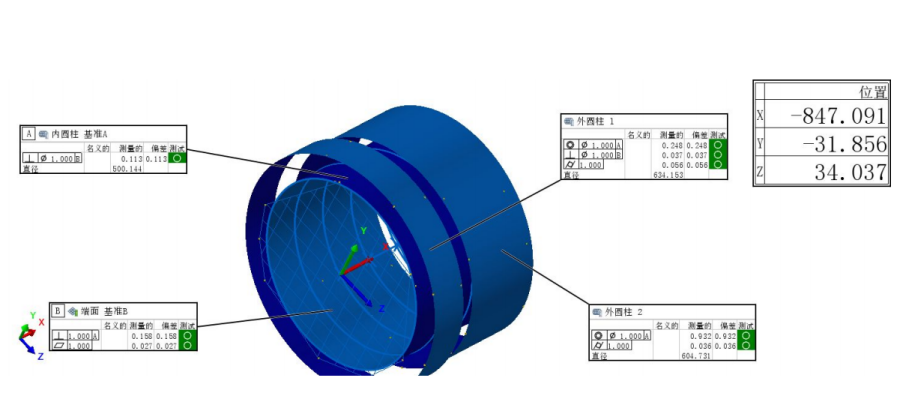
I. Directly at the Scene: Quality Risks of Hydraulic Piston Rods in Hydropower Station Projects The hydraulic piston rod is a high-precision rotating shaft component. Its key geometric indicators directly affect the safe operation performance of hydropower station equipment. Moreover, the geometric indicators of the piston rod in manufacturing often interact with each other and are difficult to handle separately: 1. Outer cylindrical size and roundness: After a certain processing or heat treatment, it is prone to micro-deformation, which affects sealing and guidance. 2. Straightness of the rod body: Long-stroke piston rods (common in large gates) have high requirements for straightness; bending will cause jamming, uneven loading and vibration, resulting in unstable equipment operation. 3. End face perpendicularity: An incorrect end face alignment with the axis will cause uneven force on the connecting parts, premature failure of the sealing surface, and affect the adjustment accuracy and sealing performance. 4. Inner hole coaxiality/positioning: This includes key connection structures such as pin holes, through holes, and internal threads, which affect assembly fit. 5. Multi-segment coaxiality and runout: The piston rod's functional segments must be coaxial; otherwise, the entire machine operation will experience uneven loading and noise. Traditional detection methods (such as calipers and micrometers) usually can only achieve single-item detection and rely on the operator's experience. The detection efficiency is low, and they cannot comprehensively reflect the collaborative influence of shape and position errors, making it difficult to meet the digital quality control requirements of modern manufacturing. II. Technical Solution: How the Joint Arm Measuring Machine Solves the Core Problem of the Piston Rod in Hydropower Stations The multi-dimensional measurement capability of the articulated arm measuring machine The articulated arm measuring machine achieves rapid three-dimensional measurement of the complex geometry of the piston rod through multi-degree-of-freedom rotating joints and high-precision probes, and is suitable for use in various workshop sites. Specific applications include: 1. Outer cylindrical measurement Visualize the overall roundness fluctuation trend of the long rod. 2. Rod body straightness analysis Fit the axis along the entire length and real-time determine the bending trend. 3. End face, perpendicularity verification Establish a reference axis with the main shaft and automatically compare the data with the original CAD model. 4. Inner hole and inner cylindrical measurement Measure the inner cavity, pin hole, etc. to obtain key data such as hole diameter, roundness and position degree. The joint arm measuring machine can play a role in providing quality control throughout the entire product lifecycle. 1. Manufacturing stage: Closed-loop control of machining dimensions; 2. Assembly stage: Pre-adjustment of overall straightness. III. From Measurement Tools to Digital Quality Platform The joint arm measurement system is not merely a measuring tool, but rather a comprehensive quality control platform that integrates measurement, analysis, reporting, and traceability: 1. It supports the automatic generation of inspection reports, and the measurement results can be exported as Excel spreadsheets and HTML format, as well as multiple predefined templates; 2. It can be directly compared with CAD models, and output deviation chromatograms;
‖图2 活塞杆测量部分数据
3. Support the import of common 3D CAD formats such as IGES and STEP, enabling full-process traceability of production quality. For hydropower stations, this means transitioning from "passive maintenance" to "data-driven preventive maintenance", reducing the probability of unexpected downtime, and extending the service life of equipment. 4. Conclusion
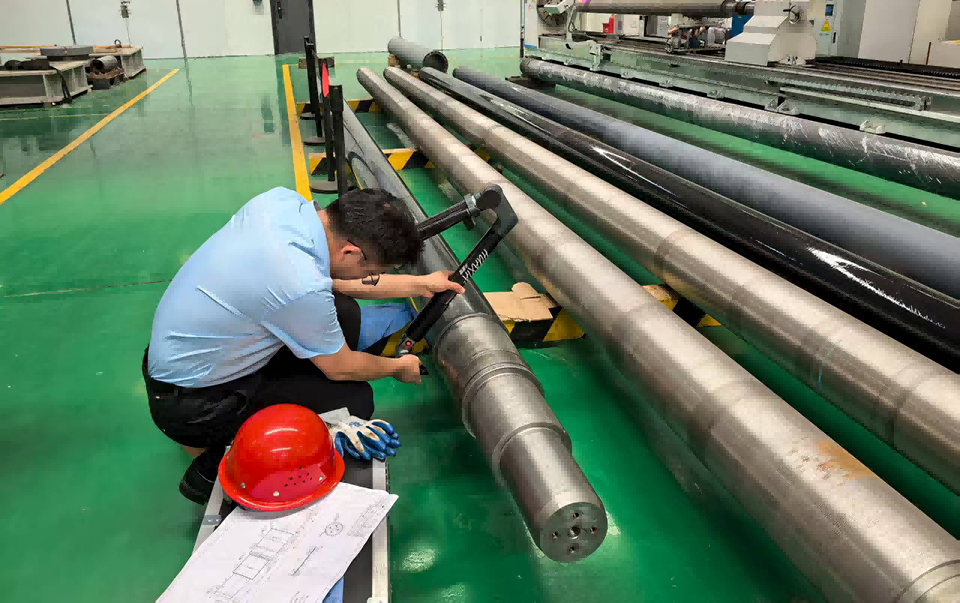
‖图3 技术工程师测量活塞杆
In hydropower station projects, the hydraulic piston rod, as a typical "multi-precision coupling structure", any form or position error may have a domino effect throughout the entire system. The joint arm measuring machine, with its ability to measure on-site, provide three-dimensional comprehensive measurement, and have traceable data, not only solves the blind spots of traditional detection methods, but also closely connects the manufacturing end with on-site operation and maintenance, forming a true quality loop, reshaping the professional standards for hydraulic piston rod detection, and leading the manufacturing industry towards digitalization and standardization.





 Return


